
Rome Stargazing: The Best Dark Sky Escapes
The artificial skyglow of Rome drowns out most celestial objects, leaving only the brightest planets visible. But just a few hours away, the true night sky emerges. Here is where local astronomers go to find the stars.
DH Research Lab
Data & Editorial Board
Expert Tested Gear & Affiliate Disclosure
This guide contains affiliate links. As an Amazon Associate, we earn from qualifying purchases.
01Understanding Local Light Pollution
Before heading out from Rome, always check the Bortle scale of your destination. The transition from the inner city (Bortle 8/9) to these locations represents a massive leap in visibility.
02Le Stelle di Galileo
Italy has a long history of astronomy, and today several regions are leading the way in dark sky preservation:
The Apennines: The mountainous interior of Italy is sparsely populated and high in elevation, providing excellent conditions for stargazing. UNESCO and IDA Sites: Several Italian parks have received international recognition for their commitment to darkness. Marine Darkness: The west coast (Tyrrhenian Sea) offers deep, dark southern horizons looking away from the mainland.
Bortle Scale
031. Abruzzo, Lazio and Molise National Park
Distance from Rome: 2 hours | Bortle Class: 3 | Best For: Closest high-quality wilderness darkness
The Abruzzo National Park is a haven for biodiversity, including wolves and bears, and its skies are just as wild.
Top Viewing Spots:
- Pescasseroli — High-altitude plateaus surrounded by beech forests
- Barrea Lake — Stunning reflections and mountain silhouettes
- Passo San Leonardo — Elevation over 1,200m with 360-degree views
Image Tip: The Milky Way arcing over the rugged Apennine peaks of the Abruzzo.
Stay22 - Abruzzo Mountain Agriturismi
“Find farm-stays in the heart of the national park.”
RATIONALE
An 'Agriturismo' in a remote valley is the perfect base for wine, local food, and incredible stars.
042. Maremma Regional Park (Tuscany)
Distance from Rome: 2 hours | Bortle Class: 3-4 | Best For: Coastal darkness and wild beaches
The Maremma is the 'wild west' of Tuscany. Its protected coastline and lack of major development mean the southern horizons are exceptionally dark.
Why go:
- Alberese Beach — One of the few wild beaches in Italy where you can stargaze with your feet in the sand
- Talamone — Historic tower with views over the dark Tyrrhenian Sea
- Saturnia — Stargazing while soaking in the outdoor thermal springs (outside the main park)
Nikon Monarch M7 8x42 Binoculars
“High-end, waterproof binoculars with exceptional low-light performance.”
RATIONALE
Perfect for scanning the dark Mediterranean horizon and the star clusters of the summer Milky Way.
053. Gran Sasso and Monti della Laga National Park
Distance from Rome: 1.5 - 2 hours | Bortle Class: 2-3 | Best For: High-altitude plateau (Little Tibet)
Campo Imperatore, known as 'Little Tibet,' is a massive high-altitude plateau (2,100m+) and is home to the Campo Imperatore Observatory.
Highlights:
- The highest point accessible by car in Central Italy
- ZERO light pollution from below the plateau rim
- Otherworldly landscape for astrophotography
Little Tibet
A vast, treeless plateau that feels like Central Asia under the stars.
Transparency
Extreme elevation means you are above much of the atmospheric haze.
Weather Alert
Even in summer, it is cold. In winter, it is arctic. Prepare accordingly.
064. Island of Elba (Tuscan Archipelago)
Distance from Rome: 2 hours + Ferry | Bortle Class: 3 | Best For: Mediterranean island darkness
While a longer trip involving a ferry, the western side of Elba faces the open sea and offers some of the darkest skies in Italy.
Sites:
- Mount Capanne — Reachable by cable car for the ultimate island view
- Chiessi and Pomonte — Remote villages on the western tip
Marine Horizon
075. Sabina Region (North of Rome)
Distance from Rome: 1 hour | Bortle Class: 5 | Best For: Absolute closest quick session
The hills of Sabina offer the first real break from Rome's light dome. Small hilltop villages and olive groves provide a good 'quick' escape.
Where to go:
- Mount Terminillo — The 'Mountain of Rome' with high elevation and decent horizons.
Quick Visit
Easily reachable for a short evening session.
Food & Wine
The region is famous for its olive oil—perfect for a sunset picnic.
Accessibility
Good road access to several high viewing points.
086. Lake Bolsena
Distance from Rome: 1 hour 45 mins | Bortle Class: 4 | Best For: Star reflections and volcanic landscapes
The largest volcanic lake in Europe. The western shore across from the town of Bolsena offers beautiful, dark views looking east over the lake.
Sony 20mm f/1.8 G Lens
“Fast, compact prime lens for wide-field astrophotography.”
RATIONALE
Capture the entire arch of the Milky Way over the volcanic crater of Lake Bolsena with incredible sharpness.
Don't Forget Your Gear
Get our Dark Sky Preparation Checklist and never arrive at a remote site missing a critical piece of equipment again.
Join 2,400+ astronomers • No spam, strictly dark sky intel
Level Up Your Astronomy Skills
Get our premium PDF guides with hundreds of pages of expert advice, gear recommendations, and step-by-step tutorials.
Browse All GuidesFind Your Darkest Sky
Use our real-time satellite maps to find locations with zero light pollution.
Launch Interactive MapPlan Your Deployment
Ready to experience these dark skies yourself? Use our interactive map to find the best dark-sky certified hotels, desert cabins, and observatories near this location.
Booking through this map supports Darkest Hour's light pollution research.
Your Learning Roadmap
You've mastered the locations basics. The next logical step in your technical progression is mastering astrophotography workflows.
MANDATORY FIELD EQUIPMENT
Celestron NexStar 8SE
The gold standard for deep-sky observation. 203mm aperture for maximum light gathering.
ZWO Seestar S50
Fully robotic imaging system. Perfect for urban environments and rapid deployment.
Peak Design Travel Tripod
Zero-latency stability for long exposure astrophotography. Carbon fiber construction.
Continue Your Research
Your First Night Stargazing: Complete 2026 Guide
Everything you need for your first night under the stars. Learn to find dark sky locations, navigate constellations, and master stargazing with zero gear.
Astrophotography on a Budget: Milky Way for Under $500
Learn to photograph the night sky with affordable equipment. Our complete gear guide shows you how to capture the Milky Way for under $500.
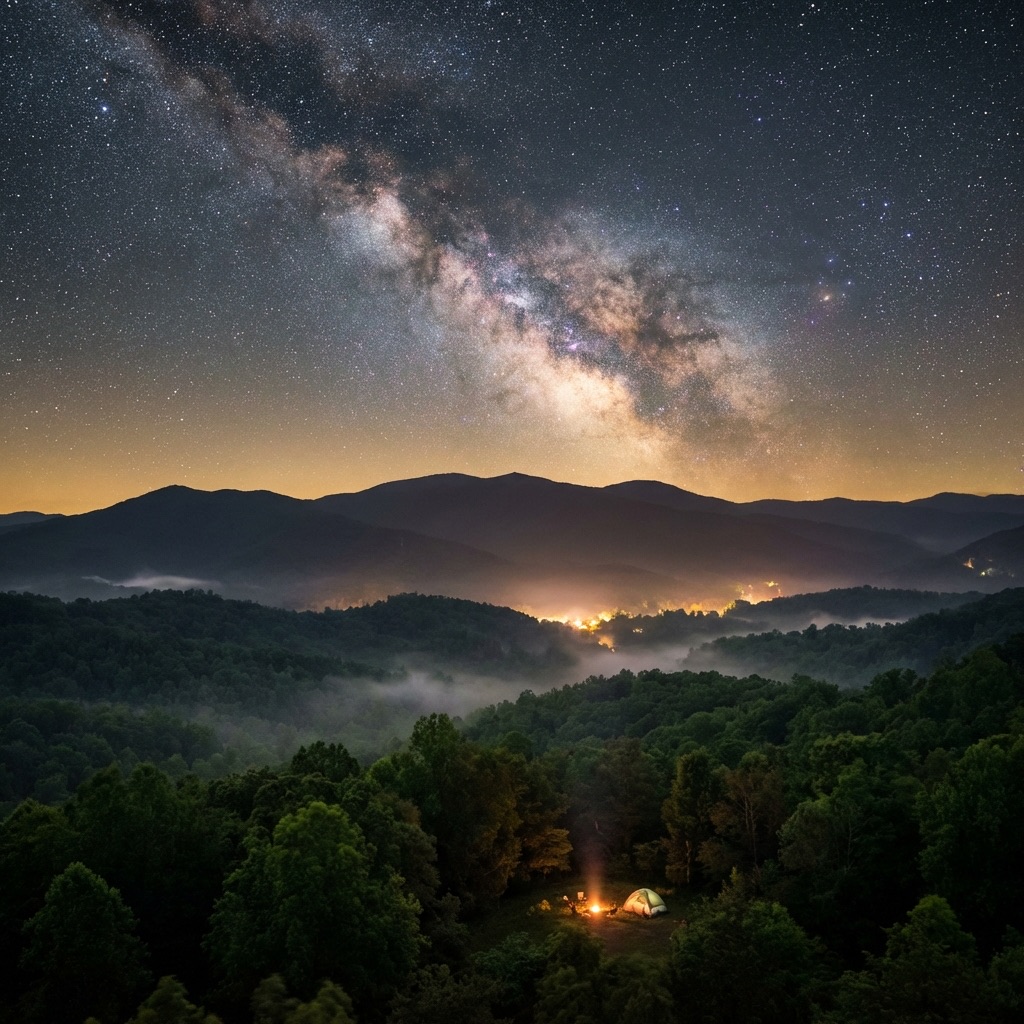
Best Stargazing Near Atlanta: 6 Southeast Dark Sky Escapes
Find the real night sky! 6 stunning dark sky spots near Atlanta—Stephen C. Foster, Blue Ridge Mountains, and hidden Georgia gems. Bortle ratings included.
End of Dossier • Research Complete